Our aim is to help UK educators make sound decisions in the adoption of AI, for impact, and in readiness for imminent changes to education in the UK, in particular the AI Tools for education initiative, and the Curriculum and Assessment Review, whose interim report states that we must equip children with the “essential knowledge and skills which will enable them to adapt and thrive in a rapidly changing and AI-enabled world”.
This free publication from MIT is very timely addition to the growing body of school-focussed AI advice literature. “A Guide to AI in Schools: Perspectives for the Perplexed” – authored by researchers at MIT and licensed under CC BY 4.0 – offers an overview of the challenges and opportunities presented by generative AI in K-12…
Ellie and I (Alan) were delighted to present on EQAITE at the recent AI in Education at Oxford University (AIEOU) conference, see photos! Thank you to everyone who got in touch as a result, to offer advice, support or collaboration, we will be in touch soon if we haven’t been already! You can see us…
The origins of EQAITE Welcome to new subscribers, This is the second in a series of blogs/newsletters from the EQAITE team. This post looks at why we have created EQAITE and how it came to be. EQAITE began as a response to a growing challenge in UK education — the pressure to adopt AI tools…
Deliver the EQAITE framework for evaluating AI tools and affordances, helping education providers in all settings – including Primary, Secondary and Tertiary education* – and determine which tools are right for which of these use cases in their setting:
Teaching With AI: help teachers bring genuine AI experiences into the classroom with AI tools such as Moral Machine, Experience AI and ML4K, navigate the challenges of AI use by students, and deliver authentic assessment, with and without AI.
Teacher Use of AI for Productivity: give teachers confidence to use AI to reduce workload and improve their effectiveness in the development of their curriculum, including curriculum design, creating resources, assessment and scaffolding, (example tools here are Teachmate or Brisk Learning).
Learner use of AI: help teachers select tools for use by learners, taking advantage of the opportunity for personalised, adaptive learning and real-time feedback which can enable faster progress towards mastery.
Deliver a range of CPD offers to support schools and colleges in bringing AI into their curriculum, including:
AI – the basics: an introduction for school leaders, heads of faculty/department, teachers and lecturers covering what it is, how can it help, pros and cons, safeguarding issues and how to get started.
Teaching about AI: for computing and digital literacy teachers, what you should be teaching about AI: how it works, issues of bias, security and plagiarism
Developing an AI strategy: for school and college leaders, integrating AI across a school, college, trust or university. Covering governance, policy, curricular integration, using EQAITE framework to assess tools, strategy, training and embedding.+
Bespoke CPD: tailored to your setting, evidence-informed training for your leaders and staff, to realise the benefits and manage the risks of AI creating better outcomes for all.
Short online courses giving an overview of the above topics, for time-challenged staff, that you can easily slot into your teaching timetable.
EQAITE Framework
A framework for assessing AI tools for teaching, learning and productivity
What is EQAITE?
The “Evaluating Quality AI for Teaching Excellence” (EQAITE) framework provides a structured approach for evaluating the quality of AI tools for teaching, learning and productivity. The aim is to assess tools against a framework of criteria, helping leaders and educators to make informed choices around whether, how, when and where to introduce AI to their practice.
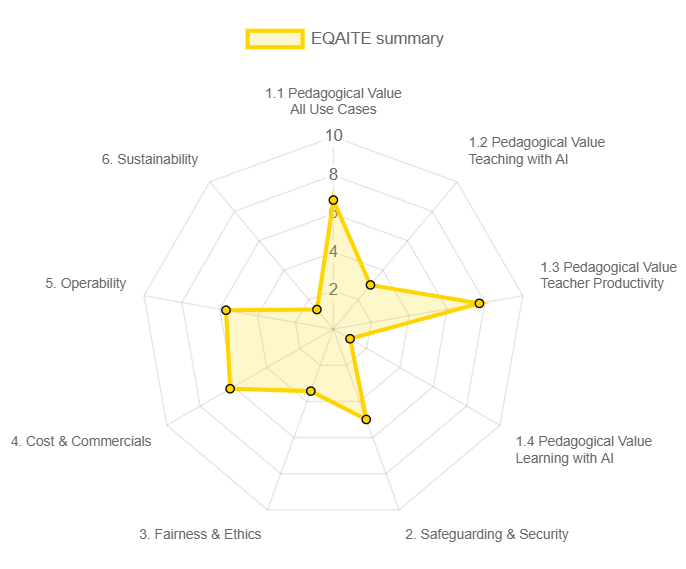
An AI tool, feature or affordance is evaluated against the framework, which produces a “radar map” summary of its strengths and weaknesses. This can be used to inform product choice, implementation strategy, staff training requirements and budgeting. In creating the framework, we have synthesised current research around AI in education, and you can see the sources we used in the appendix. Finally, the project team offer training and support to schools around AI adoption, you will find details on the project website eqAIte.org.
Why AI?
While some schools are exploring AI with enthusiasm, others are approaching it with caution, and rightly so. Concerns around bias, equity, energy consumption, and pedagogical integrity are increasingly voiced by educators, researchers and technologists. These concerns matter and must be taken seriously.
However, when critically selected and thoughtfully implemented, AI tools can also offer meaningful benefits: reducing workload, supporting personalised learning, and helping pupils make better progress – particularly in underserved communities, where infrastructure, staffing constraints, and learner needs – including SEND, EAL, and socio-economic disadvantage – limit access to high-quality education.
Why EQAITE?
The EQAITE framework places particular emphasis on equity, ensuring that AI adoption does not exacerbate existing disadvantages. Criteria are designed to help schools identify tools that support inclusive pedagogy, accessible training, and fair outcomes for all learners.
The framework does not assume that AI should be adopted, nor does it promote its use. Instead, it provides a structured way to evaluate whether, when and how AI might serve educational goals. It supports schools that choose to adopt AI cautiously, as well as those that choose to opt out entirely.
The emphasis is on informed, values-aligned decision-making, empowering educators to ask better questions, not prescribing answers.
What does EQAITE do?
Using the framework and the provided tool at app.eqaite.org, you will be able to use EQAITE to assess AI tools against many criteria, arranged into six areas of concern:
Pedagogical Value, split into:
All use cases
Teaching with AI
Teacher Productivity
Learner use of AI
Safeguarding and Security
Fairness and Ethics
Cost and Commercial Considerations
Operability
Sustainability
The resulting report includes a radar map like the example here. You can review this against your own requirements, expectations and principles. This analysis allows you to make evidence-informed decisions about AI adoption
NB the framework is still in development, and these categories may change. Click here for the EQAITE framework latest version.
About the EQAITE project
eqAIte is a collaborative project run by Dr. Ellie Overland, Manchester Metropolitan University School of Health and Education, in collaboration with Alan Harrison MA, Computer Science lecturer, trainer and consultant, and Jess McBeath, digital citizenship and online safety expert.
Our aim is to help UK educators make sound decisions in the adoption of AI, for impact and equity, and in readiness for imminent changes to education in the UK, in particular the AI Tools for education initiative, and the Curriculum and Assessment Review, whose interim report states that we must equip children with the “essential knowledge and skills which will enable them to adapt and thrive in a rapidly changing and AI-enabled world”. Find out more at eqAIte.org or contact us at info [at] eqaite . org
The team behind EQAITE
Alan Harrison MA is a freelance trainer, consultant, lecturer and tutor. He lectures on Technology Degree Apprenticeships for Ada College and delivers tutoring for two ITT providers, while writing computing content for several education publishers. He was Head of Computing and Digital Strategy at William Hulme’s Grammar School for five years, and has a degree in Computer Science and a Master’s in Education. You can find out more, including testimonials, on Alan’s websites here: httcs.online and hpro.uk
Dr. Ellie Overland is a Reader in Education, Pedagogy and Citizenship at Man Met where she founded the Computing PGCE in 2013. Ellie taught in a range of secondary schools, and worked for a Local Authority in a consultancy capacity to support school improvement before first joining Manchester Met in 2013. Following an interim period as one of His Majesty’s Inspectors of Schools, Ellie returned to Manchester Met and continues to be a practicing Ofsted Inspector across primary, secondary and initial teacher education. Ellie’s profile page at Man Met is here and LinkedIn here.
Jess McBeath is a Digital Citizenship and Online Safety expert. Jess provides comprehensive audit, evaluation, research, support, advice and education in the field of digital citizenship and online safety. Jess is an Online Safety Mark Accredited Assessorand a member of AACOSS (Association of Adult and Child Online Safety Specialists). She was awarded the NSPCC Childhood Champion Award as Schools Volunteer for Scotland 2018. Jess holds a first class degree in Linguistics & Artificial Intelligence and an MBA (distinction). Jess’s website is here: jessdigital.co.uk
If you would like to get involved, need help with the EQAITE framework or application, need support, consultancy or training around introducing AI in school, to discuss partnering with us, or anything else, please fill in this contact form. Thank you!






 eqAIte.org