Introducing EQAITE: Evaluating Quality AI for Teaching Excellence
Choosing AI-powered education tools with confidence
Introduction
Schools, colleges and universities are now overwhelmed with choice when it comes to AI tools. Some institutions have grasped the nettle and are powering ahead with AI, others are quite rightly nervous about adopting the new and daunting technology while managing the new risks it presents.
In response to these challenges, three educators have come together to navigate the information and produce a useable framework that will help leaders and educators bridge the gap between AI policy, strategy and implementation. The result is EQAITE, your one-stop-shop for evaluating AI tools, resources and affordances.
Why EQAITE?
Educators in the UK are being rapidly introduced to AI, with government messaging urging public sector workers to embrace its potential. But alongside the enthusiasm, there’s caution: official guidance warns educators to be mindful of risks, from ethical concerns to safeguarding.
Whether AI tools are adopted meaningfully depends on teacher confidence. Studies show that acceptance hinges on how teachers perceive their role in AI-enhanced pedagogy, the complexity of the tools, and potential harms. Some are already experimenting – using AI to boost productivity or trialling classroom applications – while others remain wary.
Leadership plays a crucial role. Where school leaders are proactive, AI strategies are more likely to exist. But gaps are emerging. A Sutton Trust report found private school teachers are twice as likely to receive formal AI training, and only 9% of state school teachers said their school had a clear AI strategy, compared to 27% in the independent sector. The least affluent schools are falling furthest behind.
Why now?
EQAITE responds to the challenges posed by the UK education sector and beyond, notably these key driving forces:
And across the country, the workload crisis deepens. Teachers are told AI will help, but good advice on wise adoption is scarce.
What is EQAITE?
The “Evaluating Quality AI for Teaching Excellence” (EQAITE) framework provides a structured approach for evaluating the quality of AI tools for teaching, learning and productivity. The aim is to assess tools against a framework of criteria, helping teachers to make informed choices around whether, how, when and where to introduce AI to their practice.
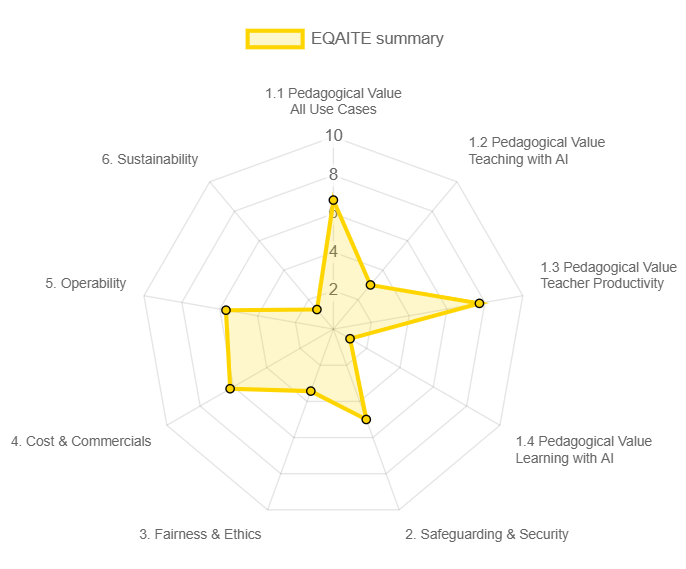
An AI tool, feature or affordance is evaluated against the framework, which produces a “radar map” summary of its strengths and weaknesses. This can be used to inform product choice, implementation strategy, staff training requirements and budgeting. In creating the framework, we have synthesised current research around AI in education, and you can see the sources we used in the appendix. Finally, the project team offer training and support to schools around AI adoption, you will find details on the project website eqaite.org.
Using the framework and the provided tool at app.eqaite.org, you will be able to use EQAITE to assess AI tools against many criteria, arranged into six areas of concern:
Pedagogical Value, split into:
All use cases
Teaching with AI
Teacher Productivity
Learner use of AI
Safeguarding and Security
Fairness and Ethics
Cost and Commercial Considerations
Operability
Sustainability
The resulting report includes a radar map like the example here. You can review this against your own requirements, expectations and principles. This analysis allows you to make evidence-informed decisions about AI adoption
NB the framework is still in development, and these categories may change. Click here for the EQAITE framework latest version.
Next steps
The EQAITE framework is now live in beta, and it’s already helping educators think more critically about the AI tools they’re using. Instead of just asking “Does this tool work?”, EQAITE prompts deeper questions, like how operable, secure, and sustainable the tool really is. Most users are starting by applying it to tools they already use, but the goal is to support future decision-making too.
One standout finding so far: safeguarding and data security are top priorities for teachers and leaders. But many are discovering gaps in their own knowledge, and in the transparency of the tools themselves. With so many AI systems operating as “black boxes,” it’s hard to know how data is handled or even what age groups the tools are appropriate for. Some tools already in use are being flagged as “limited” under EQAITE’s criteria.
Sustainability is another tricky area. Few AI providers mention it at all, and educators are unsure how to judge it. The framework is evolving to include broader definitions, like how precise a tool’s responses are, and whether it reduces cognitive load by requiring fewer prompts. This part of the model is still under active development and will benefit from wider input.
How You Can Get Involved
Explore the Beta: Try the EQAITE framework document or app with tools you already use. It’s available online here and designed to be intuitive.
Join the Conversation: Feedback from educators is shaping the next phase. Share your insights, challenges, and suggestions using the contact form on the homepage at eqaite.org or by emailing us info [at] eqaite . org
Contribute to Testing: Formal testing runs from September 2025 to July 2026. If you’re interested in participating, keep an eye out for sign-up opportunities or reach out to the project team.
Raise Awareness: Talk to colleagues, school leaders, and networks about EQAITE. The more voices involved, the stronger the framework becomes.
Subscribe to this blog for the latest updates:
About the EQAITE project
EQAITE is a collaborative project run by Dr. Ellie Overland, Manchester Metropolitan University School of Health and Education, in collaboration with Alan Harrison MA, Computer Science lecturer, trainer and consultant, and Jess McBeath, digital citizenship and online safety expert.
Our aim is to help UK leaders and educators make sound decisions in the adoption of AI, for impact and equity, and in readiness for imminent changes to education in the UK, in particular the AI Tools for education initiative, and the Curriculum and Assessment Review, whose interim report states that we must equip children with the “essential knowledge and skills which will enable them to adapt and thrive in a rapidly changing and AI-enabled world”. Find out more at eqaite.org or contact us at info [at] eqaite . org
The team behind EQAITE
Alan Harrison MA is a freelance trainer, consultant, lecturer and tutor. He lectures on Technology Degree Apprenticeships for Ada College and delivers tutoring for two ITT providers, while writing computing content for several education publishers. He was Head of Computing and Digital Strategy at William Hulme’s Grammar School for five years, and has a degree in Computer Science and a Master’s in Education. You can find out more, including testimonials, on Alan’s websites here: httcs.online and hpro.uk
Dr. Ellie Overland is a Reader in Education, Pedagogy and Citizenship at Man Met where she founded the Computing PGCE in 2013. Ellie taught in a range of secondary schools, and worked for a Local Authority in a consultancy capacity to support school improvement before first joining Manchester Met in 2013. Following an interim period as one of His Majesty’s Inspectors of Schools, Ellie returned to Manchester Met and continues to be a practicing Ofsted Inspector across primary, secondary and initial teacher education. Ellie’s profile page at Man Met is here and LinkedIn here.
Jess McBeath is a Digital Citizenship and Online Safety expert. Jess provides comprehensive audit, evaluation, research, support, advice and education in the field of digital citizenship and online safety. Jess is an Online Safety Mark Accredited Assessorand a member of AACOSS (Association of Adult and Child Online Safety Specialists). She was awarded the NSPCC Childhood Champion Award as Schools Volunteer for Scotland 2018. Jess holds a first class degree in Linguistics & Artificial Intelligence and an MBA (distinction). Jess’s website is here: jessdigital.co.uk



 eqAIte.org
Leave a comment