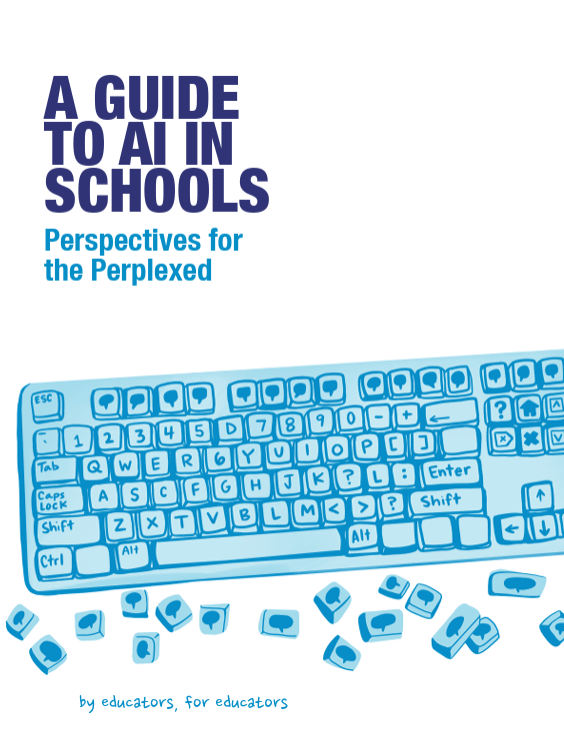
This free publication from MIT is very timely addition to the growing body of school-focussed AI advice literature. “A Guide to AI in Schools: Perspectives for the Perplexed“ – authored by researchers at MIT and licensed under CC BY 4.0 – offers an overview of the challenges and opportunities presented by generative AI in K-12 education in the US, based on interviews with over 100 educators and students. What follows is a blog post about the document written by Notebook LM, a free LLM-based tool from Google:
5 Surprising Truths About AI in Schools (From Over 100 Teachers and Students)
Introduction: The Plane is Already in the Air
A deep sense of uncertainty surrounds the arrival of artificial intelligence in education. Many educators feel like they are perpetually one step behind, or as teacher Alec Jensen of Abraham Lincoln Elementary School put it, “struggling to catch up.” The rapid pace of change has left schools anxious and scrambling for answers.
These insights aren’t just speculation. They are distilled from a comprehensive two-year project by researchers at MIT who interviewed over 100 students and teachers across the country. The goal was not to provide definitive answers, but to listen closely to those on the frontlines who are navigating this new reality every day.
The core challenge is captured perfectly by a metaphor from Steve Ouellette, Director of Technology, Learning, and Innovation for Westwood Public Schools: schools are “building the plane while we fly it.” Unlike technology that is formally adopted, AI is an “arrival technology”—it simply showed up in classrooms, forcing everyone to react. What follows are five surprising truths that emerged from those on board.
1. Banning AI Isn’t Just Unrealistic—It Might Be Unfair
A common first reaction for many schools is to simply ban generative AI. However, many teachers on the ground believe this is a flawed approach. As English teacher Sara Falls of Abraham Lincoln High School noted after exploring the issue with her department, “a zero tolerance approach is maybe not realistic.” For example, she and her colleagues realized that tools students were already using, like Grammarly, are technically AI, making a simple ban messy and complicated.
The problem with an outright ban goes beyond practicality and touches on a crucial issue of fairness. Computer science teacher Chad McGowan of Ashland Public Schools highlighted this key equity concern. When schools ban AI on school-provided devices like Chromebooks, they effectively punish students who rely on that single device for their schoolwork. Meanwhile, as McGowan explained, “the rich kids who have extra computers” at home can still access AI tools freely on their personal devices. An outright ban doesn’t level the playing field; it tilts it further in favor of those with more resources.
2. The Real Threat Isn’t Cheating, It’s Losing the Human Connection
While academic integrity is a major concern, some teachers worry about a more subtle, human cost of outsourcing educational tasks to AI. They see grading and giving feedback on student writing as more than just a task to be completed—it’s one of the primary ways they build relationships and get to know their students on both a personal and academic level.
English teacher Sara St. John of Winterset Community Schools articulated this powerful perspective, explaining why she resists the urge to use AI for grading even though it could save her significant time.
“There are [AI] tools that I could throw in my kids’ writing, and it would give them feedback about their writing, and it would score it for me… but I don’t because that’s also how I find out about kids. That’s how I get to know them. You know, they’re very honest on paper.”
This reframes the debate. The question isn’t just about efficiency or catching cheaters; it’s about preserving the essential human connection that lies at the heart of the student-teacher relationship.
3. AI Might Cost Teachers as Much Time as It Saves
AI is often promoted as the ultimate productivity tool for overworked teachers, and in some ways, it delivers. Teachers reported saving time by using AI to generate lesson plans, create detailed rubrics, and even make complex seating charts.
However, these time savings are often offset by new, time-consuming tasks. The biggest cost comes from the increased need for vigilance around academic integrity. As one high school English teacher described, what used to be a straightforward process of giving feedback now involves a preliminary investigation: “the first thing I have to do is prove that it [wasn’t plagiarized] which takes about 10 minutes of my life away.” The promise of AI as a simple productivity boost is complicated by the reality that it creates new burdens on a teacher’s workload.
4. Students May Be Losing the Capacity for “Hard Work” That Creates Thinkers
For many educators, the deepest fear goes beyond cheating to the very nature of learning itself. They worry that by outsourcing the difficult parts of thinking, students will miss out on the essential struggle that builds true understanding and intellectual character.
English teacher Sara Falls of Abraham Lincoln High School explained this “writing is thinking” argument, noting that the hard work involved is critical for developing insight and patience.
“I believe all of us – but especially in an academic context – learn what we believe by putting it in words on a page. Writing is thinking. And it’s hard. Now more than ever students need to work to cultivate the patience, the openness, and the insight to do this without AI.”
This concern is echoed by students themselves. One high schooler reflected on seeing their peers turn to AI for entire essays, voicing a worry about “how lazy our brains can become” when a machine does the essential work of thinking and writing for us.
5. The “AI Detectors” Meant to Solve Cheating Are Deeply Flawed
In response to the rise in AI-assisted writing, many have turned to AI detection software as a technological solution. However, interviews with teachers and a review of recent studies reveal these tools are far from a silver bullet and come with serious flaws.
- They can be wrong. Teachers described a case where an AI detector flagged an essay as “70% likely AI,” even though the teacher knew it was original, stating, “No, I actually worked with that kid on that essay… We put that essay together. None of it was AI.”
- They can be biased. A computer science teacher noted that detectors have a “high false positive rate for students who are not native English speakers.” This is backed by a Common Sense Media study which found that Black teens are about twice as likely as their peers to be incorrectly flagged for using AI.
- They erode trust. Beyond the technical issues, some teachers feel that relying on detectors fundamentally damages the learning environment. As English teacher Ray Salazar of Chicago Public Schools stated, if the default becomes having to “scrutinize and evaluate their work with skepticism,” then “something’s wrong” with the relationship between student and teacher.
- They are inscrutable black boxes. Even when a detector flags a paper, some teachers feel powerless to act on the information. As Alec Jensen noted, “I don’t feel empowered to really do anything with that information, because I don’t know what this tool is.”
Conclusion: What Is School For?
The insights from teachers and students paint a complex picture. AI is a tool of both convenience and consequence—a potential aid that carries the risk of undermining the very skills that education is meant to build.
Ultimately, the arrival of AI forces us to confront a deeper and more fundamental question. As teacher Alec Jensen of Abraham Lincoln Elementary School reflected, “if a robot can easily answer your homework questions, are you assigning meaningful homework questions?”
In an age of instant answers, what is the true purpose of learning, and how must our schools adapt to protect it?
 eqAIte.org
Leave a comment